


Hi guys, at this moment I am in Amsterdam taking a course on System Coaching and the module that I am taking right now is about Change Management. This is my first day but I already got fantastic ideas to share with you.
The company that I am currently work with is trying to increase the code quality and move into a stage that they can release software several times a day. I am one of the responsible persons (together with other colleagues) to drive this change! For past couple of weeks I´ve been thinking what steps should I take, and honestly, today´s course was quite enlightening and helpful towards this thinking.
During today´s training, I had the opportunity to access to change management theory and of course to a bunch of tools that sound very powerful. Maybe what I learned today is not new for you, but it was quite inspiring for me. I took the opportunity to create an agenda for a workshop that I will run within the next weeks.
I would like to list four ground conditions for Successful Change:
- New Information must enter in the system
- There is a sense of shared purpose about the change
- Everyone has the opportunity to give input on how the change will occur
- Everyone understands how input will be used and final decisions are made
Taking this into consideration, I decided to design a full day workshop around the topic of “Releasing Software Several Times a Day”.
For this event, I will invite the company´s CTO to give a 15 minutes talk about the topic. I will ask him to explain to the rest of the company why it is so important to go into this direction and why it is necessary for the company to reduce the release cycle from several days into several minutes.
I will ask him to explain what will happen to the organisation if we do not move into this direction. My hope is that everyone will understand the urgency of this situation.
Hopefully after the CTO´s speech, the audience will understand the information that was injected into the system as well as the urgency of the change. The next step is to work together with the audience.
I will ask the audience to form groups and come up with their own vision of this new company. A vision of a company that releases software several times a day, if needed… When the groups are ready with this task, I will invite each group to present their vision to the other groups. With this exercise I am giving an opportunity for everyone to provide their own unique vision of where the company should go.
After that I will facilitate a session, in which we will build a common vision for the company. We will be able to have a single vision that everyone will pursue. With this action, I believe that we will be able to build a sense of shared purpose, the next step for a successful change.
For the next step, I will use a tool that I learned this weekend. This tool is called: “Force Field Analysis”
Force Field Analysis is a useful technique that serves looking at all forces for and against a decision. In other words, it is a simple process of weighing pros and cons. When you carry this exercise you are able to plan to strengthen the forces to support a decision and reduce the impact of opposition to it.
I will ask each group to draw a pyramid and to come up with their “Forces for Change” and their “Forces Against the Change” like it is illustrated below.
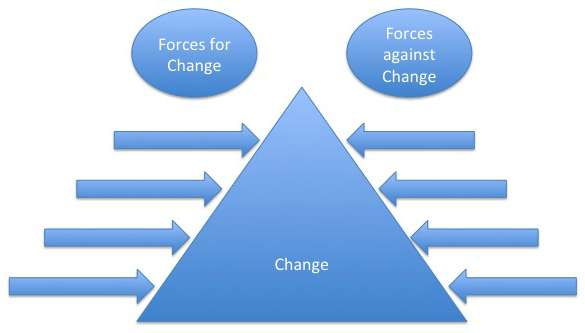
After that, ask people to rate their options from zero (very weak force) to five (this is a tornado, nothing can stop it). Ask them to present their pyramid to the rest of the audience. Repeat the exercise with the rest of the groups.
When you have the pyramids of everyone, create a big “company pyramid” moving all the forces from different teams into one single pyramid, removing repetitions. Sum all the positive forces and write the final number. Do the same for the negative forces.
This exercise will give a very good understanding on how this change is currently being received within the group. The next exercise will reveal a bit more information about the whole change. The exercise is called informal constellation.
An informal form of constellation allows a group or a team to constellate themselves with regards to a specific issue where all voices are welcome and heard. The informal Constellation is extremely useful for getting a snapshot of the system at any given moment in time. It is a very rapid way of having a group “vote with their feet”. It is most effectively used with groups of four or more members. It bypasses words, allowing a nonverbal view of a system. Below I describe how this tool is used.
- Chose a topic that needs to be discussed, in this case “Release Software Several Times a Day”. It is important to mention to the group that we are part of a “no judgement zone”. Everyone´s point of view is valid and needs to be understood by the whole team.
- Write the topic on a small piece of paper and put it on the floor. Instruct people that you will ask them 2-3 questions. They will answer by moving closer to or farther away from the topic depending on their answer to the questions. It´s important to refer there is no cross-talk during the exercise. The purpose is for everyone to become aware of how their team is expressed around this topic, to get a holistic view.
The first question should be an Opening/Establishing
“How impacted are you by the release process in our company?”
The second question should be posed after group members positioned themselves in response to the question, Polling Question:
“Why are you standing where you are standing and what´s that like?”
Ask this question to several people in the group. It´s important to create a sense of safety so that people can respond honestly. Poll from the center out by inviting somebody from close to the center, then further out, then furthest, rather then pointing to individuals.
Third question, Unfolding Question:
“How engaged are you in actually doing something about release process?”
Fourth question:
“Why are you standing where you are standing and what´s that like?”
Follow the same process for Question 2.
Fifth question, Closing Question:
“How engaged do you want to be in doing something about the Release Process”
Follow the same process for Question 2.
When you are done with these questions, pair with a colleague next to you and discuss:
“What can you do to support your last position”
“What are the actions or intentions that you can bring to move yourself closer to the position that you occupy”
I am sure that after this exercise a lot of ideas and emotions appear.
Instruct everyone to go back to their previous groups and think if anything changed on their Forces (Force Field Exercises). Give people 15 minutes to discuss. If something changed, ask them to re-write their positive and negative forces.
Afterwards, ask people to rate their options from zero to five, just like before. Ask them to present their pyramid to the rest of the audience. Repeat the exercise with the rest of the groups.
Repeat the same as earlier, create a big “company pyramid” after everyone´s pyramid is ready. Sum all the positive forces and write the final number. Do the same for the negative forces.
At this point, you will have a really good feeling how the group sees the possible change. Next step in this process is to ask the groups to come up with Action Points (activities, task forces, ideas) to reinforce the positive forces and some Action Points how the negative forces could be tackled.
Ask each group to present their Action Points to the rest of attendees. When everyone presents their action points, give the possibility to everyone in the room to vote for 6 possible action points (3 to tackle negative forces and 3 to reinforce positive ones).
At this point you should select the top 5 Positive and Negative Action Points to be implemented. After this moment, it´s a matter of creating task forces or working with groups in order to work towards the vision.
I believe if companies would do this kind of activities often they will succeed more frequent. My personal opinion is that we fail a lot because we do not involve people:If people are not involved they do not care. With this kind of approach, I truly believe that people will feel they´re listened and empowered to drive the change in their own companies.
What do you think?
I would love to get a star rating for this post:
Leave a Comment cancel
More from our blog
See all posts

I agree, Dominic. Luis is right in that change is vital and achieving it is hard. People will likely resist changes they feel not involved with. When someone understands the purpose of new things and that they will improve their situation in the future they are a lot less likely to resist against it…
Hi Luis, I totally agree with you that by involving people you will receive a lot more engagement. This kind of activities you described will create the “magic energy” you need in an organization to drive such kind of change.