Coaching
now browsing by category
What´s going on in the coach´s mind during a coaching session
 Hi guys, on my previous post I had the opportunity to present a good framework that helps coaches to develop their skills. This post is a continuation of that post, I want to write about “What´s going on in the coach´s mind during a coaching session. For this I will use the same framework and the same levels of listening presented on my previous post. Let´s take a look into it…
Level I - Internal Listening
At this level the coach is thinking just about him. During a coaching session he thinks something like: “I hear you. I have some things to add about what you said”. Basically the coach hear what is being said by the coache but we are concentrated on what it means to for us. For example, during a coaching session never happened to you that you end up in a situation thinking for yourself: “Hoooo I know the solution for that, I have the experience to solve that”? In my opinion that is a good example of Level I. You should force yourself to be fully concentrated on the speaker.
Level II - Focused Listening
On this level the coach hears the coache and accept him. He gets curious about what the coache says. He is more focused on what the speaker says. On this level the coach can interpret the words on coache´s context rather than on his own. The coach accepts what the speak says and also how is it said, it is not uncommon for the coach to use the same words or expressions back in reflection.
Level III - Global Listening
This level reveals a more global form of listening. The coach is focused on the coache but not just on his words, he can use his own posture, emotions and body language to help the coache. The coach perceives the environment around the speaker. He can place the speaker´s words, expressions, experiences and emotions in the speaker´s own context.
This blog like all the previous ones were taken out from Lyssa and Michael training. For more information about their trainings go to Agile Coaching Institute.
Thank you so much for your time.
Did you like this post? Do you want to get more in the future? Subscribe my newsletter below and follow me on twitter: @lgoncalves1979.
I am trying to improve these blog posts with a help from professional designers and editors to give you even more valuable content. If you want to support me on this effort, feel free to contribute with any amount of money that you think it´s fair.
Thanks guys,
Luis
Levels of listening during a coaching conversation
 Hi guys, in my last posts I discussed about “The arc of the coaching” and about “Coaching focus”. I want to devote next two blogs about listening levels and what´s going on in the coach´s mind. I want to present a good framework that helps coaches to develop their listening skills - “Levels of listening”. The framework can be found more in details at the school of co-active coaching, but it was brought to me by Lyssa and Michael. This framework presents three levels of listening, let´s take a look at them…
Level I - Internal Listening
It´s about me, me, me, me. At this stage, everything what the coach listens to, is about himself/herself. The coach might be present and might be playing some attention to a speaker, but everything what the speaker says, is interpreted by the coach´s lens.
Level II - Focused Listening
Hard-wired connection. At this level there is a strong connection between the coach and the speaker. The coach is fully concentrated on listening what the speaker says. At this stage, the coach listens and responds in the moment with questions and silence that help the speaker to move through his/her problems.
Level III - Global Listening
Everything in the environment is used, including your intuition. At the level III, the coach uses everything available in the environment to perform his coaching session. For example, the speaker´s tone of voice, body language, emotions, etc., all these can be used by the coach. Like Lyssa and Michael say “this is where intuition lives”. This is the highest level of listening.
During a coaching session it´s normal to go trough different levels of listening, especially new coaches will spend a lot of time on Level I. It´s ok, but if they are aware they can always try to jump to level II. As soon they become more mature, they will spend less time on Level I and move towards level II and III. Lyssa and Michael tell us that a good way to increase the time that coaches spend on level II and level III is to enter each conversation with a fresh mind. We never know what the person will say, so be fully concentrated on a speaker to fully understand him/her.
Did you enjoy this post? Leave some comments ;)
Did you like this post? Do you want to get more in the future? Subscribe my newsletter below and follow me on twitter: @lgoncalves1979.
I am trying to improve these blog posts with a help from professional designers and editors to give you even more valuable content. If you want to support me on this effort, feel free to contribute with any amount of money that you think it´s fair.
Thanks guys,
Luis
Coaching focus during Iteration
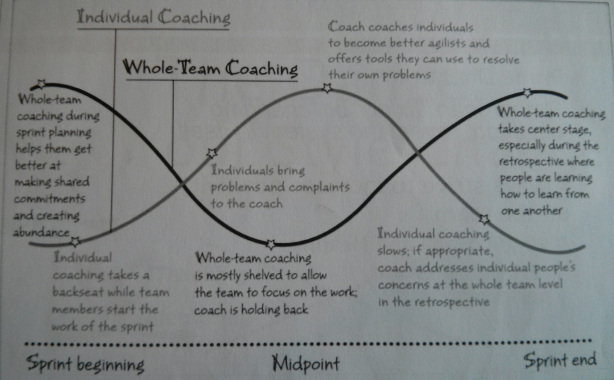
Hi guys, in my last post I explained a tool that I learned in one of Lyssa´s and Michael´s workshop. This tool is a great guidance for coaches in their coaching sessions. Now I will explain where you coaching focus should be placed. During an iteration, a coach must be aware that sometimes his coaching skills are needed to help both teams as well as individual team members. So let´s see when these different skills are needed…
In the beginning of each iteration, the coach must lead the team as a whole unit. Activities, like an iteration planning, require the coach to fulfill all elements in a group. At this point, there is not much work for individual coaching.
As soon as the iteration begins, team members approach the coach with their specific problems. Here, the coach must give an attention to each of them. At this point, the team coaching is not needed. The further the iteration proceeds, more attention towards individuals is required.
When the iteration reaches its end, team coaching is again desired. Activities, like retrospectives, are fundamental and here the coach must help the team as an whole unit. The coach will immediately address individual concerns together with the team, making the individual coaching almost no existent.
Below you can find a picture I took from Lyssa´s and Michael´s material - Coaching Agile Teams Workshop, that concludes what I wrote. The reason why I conceived this post is to create awareness among agile coaches. Coaches need to be aware that we need different skills for different situations. I believe, to be a good agile coach, we need to master not only the individual coaching but the team coaching as well.
Hope you liked this post.
Did you like this post? Do you want to get more in the future? Subscribe my newsletter below and follow me on twitter: @lgoncalves1979.
I am trying to improve these blog posts with a help from professional designers and editors to give you even more valuable content. If you want to support me on this effort, feel free to contribute with any amount of money that you think it´s fair.
Thanks guys,
Luis
Arc of the coaching conversation, a tool to help coaches
Hi guys, this blog will be about coaching. I want to bring you a simple tool that I learned in Lyssa´s and Michael´s workshop few months ago. I believe this is a fantastic tool, especially for beginner coaches. It´s a great way for them to learn how to keep a coaching session. The tool is called the “Arc of the coaching conversation” . Below you can see its representation, this picture was taken from Lyssa´s and Michael´s material - Coaching Agile Teams workshop.
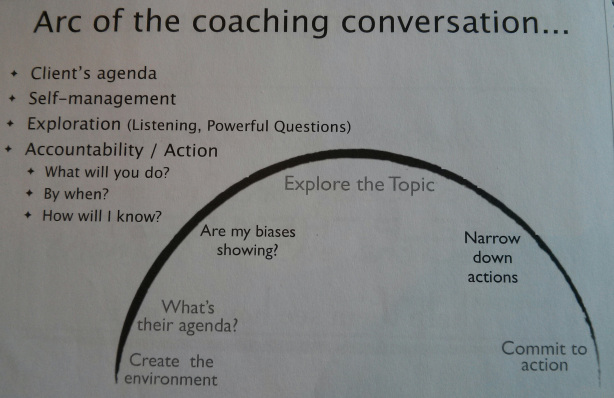
A coaching session usually initiates because a coachee needs to take one or several things out of the mind and he/she needs to be heard. The coach must create the environment in order to make the coachee comfortable for a discussion. The most important characteristic for a coach is the listening part. A great coach is a great listener. Try to think about it and do not interrupt the coachee at any point. You will have an urge to interrupt him/her, you will start to think yourself that you know the answer and you don´t want to wait to give it to him/her… Do not do that, instead, let the person release the feelings. You must self-manage yourself.
At some point, you must be sure that you understand exactly the couchee´s problem. Try to use the phrases, such as “If I understood correctly, the problem is…” This will allow you to confirm the problem and give you a better understanding what does truly bother the person. After understanding hiser/h problem, start to explore the topic. At this point you should use powerful questions. Here under “Skills for Agile Coaches/Powerful Questions Resources” you can find several powerful questions that can be used. After some time, using exploration and powerful question, the coachee will find some possible solutions for his/her problem.
It is your job as a coach to help him to narrow down actions. Together you should figure out which approach he/she wants to try first. After that, specifically ask what he/she will do, by when and how will you know what was the result. This will end the coaching session.
I personally think this is a good way to keep a coaching session valuable and I wanted to share this with all of you. Hope you enjoy it and find it useful.
Did you like this post? Do you want to get more in the future? Subscribe my newsletter below and follow me on twitter: @lgoncalves1979.
I am trying to improve these blog posts with a help from professional designers and editors to give you even more valuable content. If you want to support me on this effort, feel free to contribute with any amount of money that you think it´s fair.
Thanks guys,
Luis
 D5 Creation