

Hi guys, I am sure that most of you have, at some point, had performance issues within your teams, problems with teamwork, as well as team spirit.
In this post I want to talk about how to help a team to improve their teamwork. For this post I will have a development team (Scrum Team) in mind, but this idea can be applied to any dysfunctional team. The ideas used in this post came from different sources: My own experience and the experience of my team, as well as from a course given by Lyssa Adkins and Michael Spayd.
An important aspect that Lyssa and Michael emphasized in the course was that when you have a problem caused by the poor implementation of Agile you should address it directly; the Agile values should be reaffirmed and the system should be revealed to itself.
This is what I mean when I say the problems should be addressed “directly”: You should state the problem as you see it and then ask the team what they want to do about it. The phrase “Reaffirmation of Agile” means that you should retrain some of the Agile values or principles that are not present anymore.
“Showing the system to itself” means showing the system to the people involved through observation of what is going on (one useful exercise to achieve this can be found here).
I wanted to give you some background information because I believe that it will be extremely difficult to tackle a problem using any kind of activity if your team does not see that problem and, most importantly, if they are not interested in solving it.
With the assumption that people will try to solve the issues present, below I am presenting various activities that can be seen as a possible way to restore the energy and good practices of the team and improve teamwork. These exercises can be used as part of a two-day team building exercise.
In my humble opinion, the first thing that we must ensure in order to have a successful team is to establish a common goal for all members of the team. In my case I am talking about a development team, so I believe the common goal is to deliver a high-quality product to the customer. In this situation the Product Owner has a key role as the master of the product vision and the one responsible for sharing that vision (as well as for making sure that everyone understands what product should be built).
I am going to go a bit further and say that the Product Owner is the one ultimately responsible for creating the common goal for the team.
A possible exercise would be to ask the Product Owner to prepare a press release and then to present it to the team. With this exercise the team will be able to see the big picture and understand WHY they should work in a team and WHAT they need to accomplish as a team.
In my opinion, this exercise is important for two reasons: On the one hand, if everyone in the team knows what they need to do, the exercise is reaffirming the common goal, while on the other, if the team members do not have a clear idea what their common goal is, having this exercise will help them to create the necessary common goal.
The exercise should take 2 hours, which should be enough for the Product Owner to explain the vision and to answer any possible questions.
Hopefully, with the above exercise, the team will have a common goal and can move toward the next step. Some years ago I read a book called “The five dysfunctions of a team“. The second exercise I am going to present here is based on this book, which discusses why even most successful teams struggle to get good results. Below you can find the pyramid of dysfunctions discussed in the book.
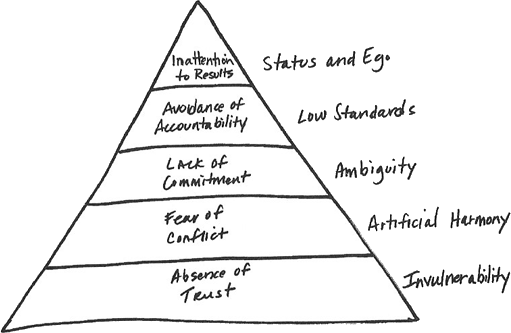
Presenting this pyramid to the team could be the second exercise. Based on my experience, most of the team members will identify at least one problem from the pyramid. Visualizing this will make them think a bit about the status quo situation while realizing that much is required to be done in order to have a great team. I think one hour should be enough to familiarise the team with the pyramid and to answer all their questions.
Since the base of the pyramid forms from an Absence of Trust, I will focus on an exercise for improving this specific aspect. My team tried this exercise some weeks ago. Clearly, we had problems in the team and lack of trust was one of them. To improve the situation, the facilitator of the meeting came up with an exercise for the team: “The Appreciation Exercise”. The point of the exercise lies in answering the five questions presented in the following picture:
Important: In order to answer the fourth question, the team should express their request as a wish. This is an awesome opportunity to use NVC. Although seemingly a really simple exercise, it makes a difference: The participants will connect with their feelings, emotions, and wishes. But make sure you reserve half a day for this exercise, as you will want to spend a decent amount of time on it.
It is too early to say, in my case, if this exercise really worked, but one thing is for sure – the spirit of the team after the exercise was quite high and all of us were really pleased with the outcome. I am sure that everyone left the room eager to improve the existing situation and improve the overall teamwork. It is important to realize that it takes time to see the results of this exercise, because these issues cannot be solved in a day or two, but it is certainly useful for bringing the team together.
After the “Appreciation exercise”, it might be the right time to refresh the Agile/Scrum values.
This exercise is about reinforcing the Scrum values. Lyssa Adkins uses the metaphor of a tree, stating that in order for a team to be highly productive, they need to have strong roots. When the roots are strong and solid the tree can grow and flourish, bearing beautiful fruits. Below you can see Lyssa’s example:
If you prefer an youtube explanation you can find it below.
Commitment is the state or quality of being dedicated to a cause, activity, etc. A commitment should never be broken and if it is broken it was not a commitment but an empty promise and a lie. In the Scrum world this means that everyone involved in developing a product is committed to working towards a common objective.
Courage is the ability to confront a fear, pain, a danger, an uncertainty, or intimidation. In software development all these feelings will be always present and it is up to the team members to try to dispel anything that prevents them from being successful.
Openness is the ability to be open to new ideas, new approaches and new ways of working. This is a fundamental state in Agile software development because every day teams encounter different problems that need to be approached differently, so being open is mandatory for achieving success.
Focus is the process of selectively concentrating on one aspect of the environment while ignoring other things. In software development this means teams should completely concentrate on one topic at a time, they should not start a new topic before finishing the previous one.
Respect is a feeling of deep admiration for someone or something elicited by their abilities, qualities, or achievements. In Scrum all team members interact closely; respect is mandatory for such relationships to work.
In this blog, you can find another point of view on Scrum values. I believe one hour should be enough to refresh the Scrum values within the team. After this exercise they will be ready for a more practical approach.
At this point, with the values written on a flip-chart, the team is ready for a new exercise. Make sure to reserve half of a day for the next exercise. By now you will need a tool to help the team recap the basics of Scrum and I believe the Lego Scrum is highly effective for that.
The goal of the game is to simulate every aspect of the Scrum process: the team members will be asked to build an entire city using Lego blocks. The team will have to put in practice everything learned previously. More details about the Lego Scrum can be found here.

https://www.flickr.com/photos/bdesham/2432400623/
After all these exercises I believe the team will be ready to start all over again and start working better as a team delivering software products of higher quality.
I do not expect to find a super-productive team upon arriving to the office right on the next day after the exercises :) This is only a starting point—like I mentioned in my second post, there can be five dysfunctions within a team and the exercises that I proposed are just for tackling the most fundamental problems, such as lack of trust.
It is up to the Scrum Master or Agile Coach to continue working with the team in order to help them to overcome problems and to become highly productive as a team.
I hope you’ve enjoyed this series of exercises. If you want to try them with your own team, I would like to ask you for a favour: Please, come back and share the results. :)
I would love to get a star rating for this post:
I love this article, excellent, practical advice. Definitely going to give this a try. A question I have, with regards to the pyramid of dysfunctions, what is the objective here. Do you just present it to the team and see if they have questions? What is the purpose?