http://www.flickr.com/photos/bluespringsfordparts/
Every day we hear how important is to have purpose in our jobs and in our life. Daniel Pink refers in his book “Drive” that in order for us to be truly motivated with our work we need to have a feeling of purpose, mastery and autonomy. Therefore, this post will focus on the purpose component and on the difficulty of finding this purpose at work. What happened in our society that took the purpose away from employees and people? I believe, we can thank the industrial era. Keep reading to find out why.
In the beginning of the twentieth century, the society was much more stable, static and not dynamic. There was not much competition and markets did not move the same speed as they move today. All these factors allowed organisations to centralise decisions and impose top down rules that everyone had to follow. Managers were basically the gate keepers of all decisions and then delegated execution down to the workers. As Thomas Kenneth writes in his book “Intrinsic motivation” : “Managers became the keepers of purpose. Knowing about task purposes and their accomplishment became unnecessary for workers”.
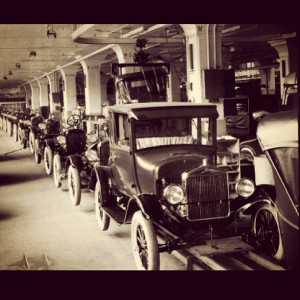
The workers at the end of the line limited themselves to implement the orders that came from upper levels because they did not know anything about the “big picture”. They were mainly workers in assembly lines putting component pieces together and had no vision of the final product. These people were under close supervision by their superiors who enforced compliance using punishments or extrinsic rewards. It was the era of mass production.
So what is the difference to today’s work? And why it is so important for people to have purpose at work?

http://www.flickr.com/photos/healthblog/
Today’s society is completely different from the society a hundred years ago. The pace of today’s society is unpredictably fast and chaotic. The predictability from other times is not present anymore. Another thing that differs is the type of work. In the industrial era, most of the jobs were in manufacturing, today most of the jobs are in services, making most of today’s workers knowledge workers instead of manual, manufacturing workers.
Organisations must be fast, must innovate and must adapt to their customer needs. Decisions cannot be made in centrally anymore, this would be too slow and not efficient for companies. In order to solve these problems, companies need to trust on their employees allowing them to decide what is the best for the customer and help them to solve their problems. This requires companies to self-empower people and give them freedom to enable them to decide what is the best for the current environment.
Thomas refers in his book: Intrinsic motivation at work: “Organisations need workers to take active responsibility for handling more and more of the uncertainties involved in the accomplishment of their purposes. So organisations have been forced to flatten their hierarchies and push decision making down to workers. Workers are called on to adapt to customers’ needs, simplify and improve organisational processes, coordinate with other workers and teams, and initiate ideas for new products and services.”
Today, more and more it is necessary for companies to allow employees to be part of the company’s mission and purpose. When companies allow this, employees will find something with what they identify. They will find the purpose for their work and will help the company succeed. But this is not that simple, most of the management books and universities refer to material that is sometimes outdated. Management literature today points to material that made sense in the industrial era but not today, not anymore. Most of the graduates or people who buy books about this topic are advised to follow old fashioned management tips that do not apply to our modern society anymore. So it is our job to help companies with this difficult task of creating an environment where people feel the purpose in everything they are do at work.
Did you like this post? Are you interested in this topic? Subscribe my newsletter below to get access to weekly news from my side.